Dear respected reader,
Namaste. In addition to the classic PDF Dr. B Madhava Puri has published since the beginning of the millennium, we’ve included all the newsletter’s contents here in this post.
This month’s issue includes affectionate guidance from our beloved spiritual masters: Srila Prabhupada, Srila Sridhara Maharaja, Srila Govinda Maharaja, Srila Acharya Maharaja, and Sripad Puri Maharaja. At the end, we share updates from a recent article by a cancer researcher who shared her experience of the BVISCS, the BVISCS’s new Garden State of Mind Podcast, and a blog post about mechanistic and organismic approaches to personal and organizational development. Clicking most images throughout the newsletter leads to the relevant video/link.
We encourage you to contact us with any questions or comments that arise. Kindly consider clicking the following image to access the PDF of “ŚRĪ MAHĀNET | Q3 2026”:

ALL GLORY TO ŚRĪ GURU AND ŚRĪ GAURĀNGA
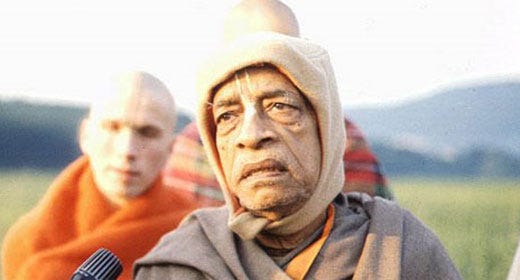
Śrīla A.C. Bhaktivedānta Swāmī Prabhupāda
The statement here that the Lord manifests Himself before the devotee in the form in which the devotee likes to worship Him indicates that the Lord becomes subordinate to the desire of the devotee — so much so that He manifests His particular form as the devotee demands. This demand of the devotee is satisfied by the Lord because He is pliable in terms of the transcendental loving service of the devotee. This is also confirmed in Bhagavad-gītā (4.11): ye yathā māṁ prapadyante tāṁs tathaiva bhajāmy aham. We should note, however, that the Lord is never the order supplier of the devotee. Here in this verse it is particularly mentioned: tvaṁ bhakti-yoga-paribhāvita. This indicates the efficiency achieved through execution of matured devotional service, or prema, love of Godhead.
Bhāgavatam 3.9.11 Purport
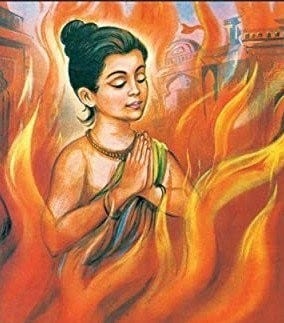
ŚRĪ ŚRĪ PRAPANNA-JIVANAMRTAM
by Śrīla Bhakti Rakṣhaka Śrīdhara Deva Goswāmī Mahārāj
Verse 4.8
hari-vimukha-saṅga-phalasyānubhūti-svarūpam—
varaṁ hutavaha-jvālā-pañjarāntar-vyavasthitiḥ
na śauri-chintā-vimukha-jana-saṁvāsa-vaiśasam
(Kātyāyanasya)
A realization of the result of associating with those who are averse to the Supreme Lord Hari—
One should endure the pain of being locked in a cage surrounded by blazing fire, rather than keep the distressing association of persons averse to Kṛṣṇa consciousness.
—Kātyāyan
WORDS OF OUR GUARDIANS
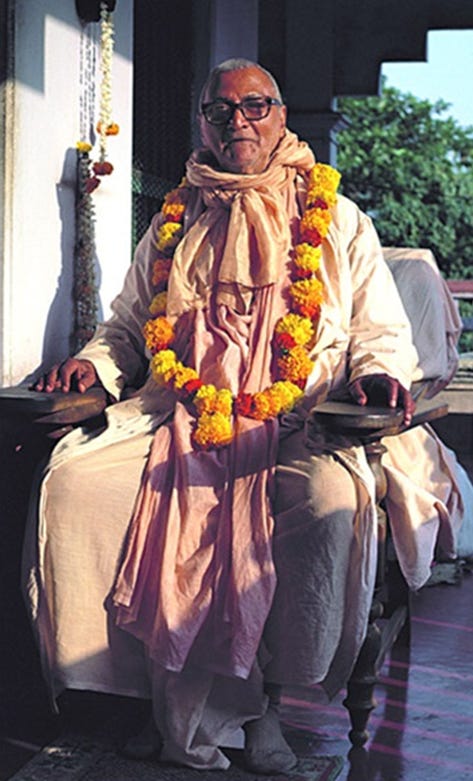
Śrīla Bhakti Rakṣhaka Śrīdhara Deva Goswāmī Mahārāj
from The Loving Search for the Lost Servant, Chap. 9 Knowledge-Free Devotion
The seal of ego
We have only to break the seal of the ego, and the natural flow of divine love will come and automatically help its own cause. Such an arrangement is there for us by which we may return home. We won’t feel that it is a tedious, laborious journey. We will be carried by our natural attraction, independent of external guidance. The tendency within us for divine love can understand its own soil; it has that natural gift of attraction. An automatic attraction will be there for our home; no scientific search is necessary.
Rather, we will have to put a stop to our intellectualism, ambition, and aspiration. It is unnecessary. It is a wild goose chase. It will never help us to reach our goal. The heart will reject that. There will be no room for any suspicion at all. It is an infallible, natural, complete selection. So, we should try to find that natural thing which cannot be acquired as the result of any long program of research. It is quite natural. It is only the artificialism within us that must be removed and bid adieu forever. And the reactions that we have acquired after so long in our false journey will evaporate out of their own accord. They will present no problem. This is certain.
There will be no reaction, and no necessity of finding any new discovery or invention. Once achieving that realization, we will see that our “progressive-knowledge-civilization” is all redundant.
No intellectualism is required. Just as a child knows his mother, we can recognize our real home. In the midst of so many cows, a calf will run to its own mother. They have some instinctive scent or a natural guidance that directs them. In the same way, no trouble, no investigation, no experiment, or suspicion is necessary. Devotion to Kṛṣṇa is automatic, natural, happy, and spontaneous. It is a spontaneous life, an automatic flow, a natural movement.
Our real interest is love. Love is independent of everything. It is the innermost substance in our existence. “Try to dive deep into reality”, we are told. “Dive deep into reality, and you will find your home there in that divine realm. You are a child of that soil.” That is the message of Śrīmad Bhāgavatam and Śrī Chaitanya Mahāprabhu. And that is not a very meager conception, an abstract or hazy dream, but that is the most intense and concrete reality.
Śrī Chaitanya Mahāprabhu demonstrated this by His character, by how intensely He searched for Śrī Kṛṣṇa, and by how intensely and deeply He engaged Himself in the līlā of Kṛṣṇa, ignoring so many facts which seem concrete in the outside world. Forgetting everything, despising everything which is so important to us, He neglected all other functions and considerations of duty. He engaged Himself in Kṛṣṇa-līlā so deeply and intensely—diving deep into it—that it captured His whole heart so much that He was externally found to be helpless.
Chap. 10 The Holy Name
If it is to be effective, the sound of the Holy Name of Kṛṣṇa must have a divine quality. The Holy Name of Kṛṣṇa which is infinite can do away with everything undesirable within us, but the Name must be invested with a real spiritual conception. It must not be a mere physical imitation produced only by the help of the lip and tongue. That sound is not the Holy Name. If it is to be genuine, the Holy Name of Kṛṣṇa, Hari, Viṣṇu, or Nārāyaṇ must be Vaikuṇṭha-nām: it should have spiritual existence, divine backing. That principle is all-in-all in vibrating the Holy Name.
We are concerned with sound vibration that has spiritual depth. The physical imitation of the Holy Name is not the Name proper; it is not śabda-brahma, divine sound. Only imitation sound may come from the plane of mundane conception. The Holy Name of Kṛṣṇa means divine sound; it must have some spiritual background. Something spiritual must be distributed through the physical sound.
In the case of a capsule of medicine, the capsule is not the medicine; the medicine is within. Externally, one capsule may look like another, but within one capsule there may be medicine and within another there may be cyanide. The capsule itself is not the medicine. So, it is not the sound of Kṛṣṇa’s Name that is Kṛṣṇa: Kṛṣṇa is within the sound. The Holy Name must be surcharged with the proper spirit, not any mundane sentiment.
Even the followers of the impersonal Śaṅkar school have faith that the Name is not confined within the jurisdiction of physical sound. They consider it to be within the mental plane, within the plane of sattva-guṇa. Unfortunately, they think that the Holy Name is the product of māyā, or misconception, and so they conclude that the names of Hari, Kṛṣṇa, Kālī, and Śiva are all one and the same. The Ramakrishna Mission and the Śaṅkar school both preach in that way. But that conception also has its origin in the plane of misunderstanding.
DIVINE INSTRUCTION
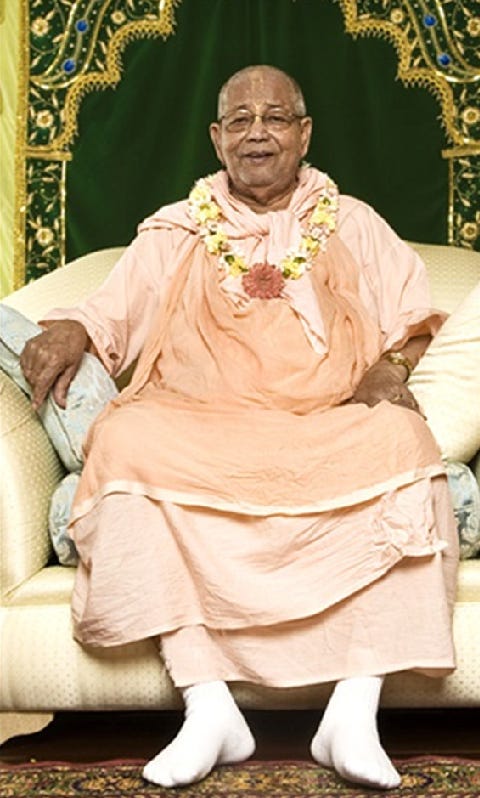
Śrīla Bhakti Sundar Govinda Deva Goswāmī Mahārāj
from Golden Reflections, “Earlier Days”
Question: In order that Śrīla Guru Mahārāj was able to go on these tours his health must have improved considerably.
Śrīla Mahārāj: Yes. Although Guru Mahārāj’s health was not so good he would still go on these tours.
You would be surprised to hear that at that time no qualified person was in Śrī Chaitanya Sāraswat Maṭh who could maintain his Mission. When he was fifty-five years old Śrīla Guru Mahārāj made a will. He made me the Sevāite and Āchārya; Goswāmī Mahārāj, Jājāvar Mahārāj, and Guru Mahārāj’s godbrother, Sakhī Bābu, were trustees, and perhaps Paramahaṁsa Mahārāj was an adviser. Śrīla Guru Mahārāj thought that they would stay and he would leave, and therefore he made them trustees, but they all left this world before him. In 1964, a few years after he passed the fifty-eight years that some expected him to live, he made a registered “Deed of Gift and Settlement”.
He installed Gāndharvā Govindasundar about four years after I came to the Mission.
The Temple was begun perhaps in 1955. First there was one thatched house, then a second, then the building of bricks, mud, and plaster, and after that gradually came the other buildings. The year I went to Badarik Ashram we collected Rs 5,000, and on returning I proposed to Śrīla Guru Mahārāj that we shall make a Temple. Śrīla Guru Mahārāj said, “With only Rs 5,000 what will you be able to make?” By the desire of Śrīla Guru Mahārāj I then called Jājāvar Mahārāj. He came and Madhusūdan Mahārāj also came. It was Gaura Pūrṇimā time, and they went preaching for the festival to be held here. At that time a big donor came: Kiśorī Mohan Dās Vairāgya. His name is on the first of the marble plaques beside the Mandir. With his promise to give money for the Temple, Śrīla Guru Mahārāj started the construction. I don’t have a clear memory of historical dates but it was maybe 1955. Kiśorī Bābu then gave maybe ten or twelve thousand rupees—a lot of money at that time.
At first the raised Deity room and roof were finished but there was no veranda. Then the veranda came, after which Śrīla Guru Mahārāj installed there the Deity. I can remember that the first abhiṣek of the Deity was in the old building. The Deity therefore must have first been installed there.
Question: When the Temple was only a temple room with no veranda, where did the devotees do bhajan?
Śrīla Mahārāj: The devotees held bhajan in a thatched shed in front the Temple, like a small Naṭ Mandir. It was made of bamboo and corrugated tin sheet. Another person, a lady, also gave some money towards the Naṭ Mandir.
A little later when Kiśorī Bābu left his body, only the ground floor of the Temple had been completed. In order to raise funds to continue building, some devotees of Śrīla Guru Mahārāj made further collections in addition to the annual parikramā tours by train and the Badarik Ashram pilgrimage. We continued those tours every year from 1953 until 1979. After Śrīla Swāmī Mahārāj’s disappearance when the Western devotees started coming, I no longer had the time to make the parikramās. Also some money started coming in from other sources, so for various reasons we stopped the parikramās. We are very few devotees here, and mainly it was due to a shortage of time that the parikramās were stopped.
Question: How long did it take to build the Temple?
Śrīla Mahārāj: The Temple took twenty years to build, and when it was completed there was still no Naṭ Mandir. Around 1975 a lady devotee of Guru Mahārāj promised Rs 5,000 and we started the construction of the Naṭ Mandir.
Up until close to the time of the completion of the Temple there was only one other building of bricks: the building of Śrīla Guru Mahārāj. The Naṭ Mandir was built after 1975 as was the gośālā [cowshed] by my present house. This building where I now stay was made also around that time. This was not originally to be my house but it was intended to be the kitchen.
One devotee, Banoyārī Lāl Siṁhāniyā, wanted to fulfil the wish of Śrīla Guru Mahārāj to make a kitchen building. I considered it would be good to make a two-story building so cooking could continue above water level during the time of flooding. Sometimes the water is more than five feet deep. So by making a two-story kitchen, when the flood comes we could move everything upstairs and still be able to cook. Throughout the rest of the year we could cook downstairs, and during festivals we could cook upstairs as well as down.
When Śrīla Guru Mahārāj saw it, he told me, “Now you should take the upstairs section and live there.” Previously I lived in the small southerly room on the roof of the Naṭ Mandir, but that was not sufficiently big for my many books and other things.
Another factor that decided my move was that especially in the rainy season it was quite far from the two-story kitchen to the Temple. The path became slippery and it was difficult to take bhoga from this building all the way to the Temple every day. Therefore, for convenience, the devotees still tended to use the old small kitchen close to the Temple.
Many big festivals happen here and at those times we would use this kitchen below my room, but generally throughout the year the small kitchen would be used.
As they were using the small old kitchen so much, I asked Śrīla Guru Mahārāj, “Now we have some chance of money, shall I make a big new kitchen at the site of the old small one close to the Temple?”
He agreed. The old kitchen was then demolished and nicely rebuilt; and that is the kitchen which is now used all the time.
I came to stay in my present room in maybe 1982.
In 1973 the Temple was completed. Then the double-story kitchen was made and the Naṭ Mandir was begun. The houses where Kṛṣṇamayī Didi and Śaṅkarī Didi used to live were constructed earlier, about 1963, as was a third house where Dharma Didi used to stay.
Gradually the Maṭh’s land area increased during the time the Temple was being built. Siṁhajuli, where the rice is grown for the Maṭh, was purchased in 1962. Śrīla Guru Mahārāj himself used to oversee the cultivation of that land. During cultivation we would go there daily by bicycle, but Śrīla Guru Mahārāj would go only every few days and he would take a rickshaw. At that time the eight kilometer journey cost two rupees. Only if necessary would he go daily. Satīṣ Prabhu also helped much with the cultivation in Siṁhajuli.
In the very early days of Śrī Chaitanya Sāraswat Maṭh, Satīṣ Prabhu stayed here. Nobody wanted to stay without a roof, but Satīṣ Prabhu happily stayed here and he helped Śrīla Guru Mahārāj to make the thatched house. He was the very first person to come and stay on the land after Śrīla Guru Mahārāj purchased it.
Guru Mahārāj himself planted the compound hedge and he did much other physical laboring work around the Maṭh. I also helped Śrīla Guru Mahārāj with the laboring duties in the Maṭh compound.
SPIRITUAL GUIDANCE
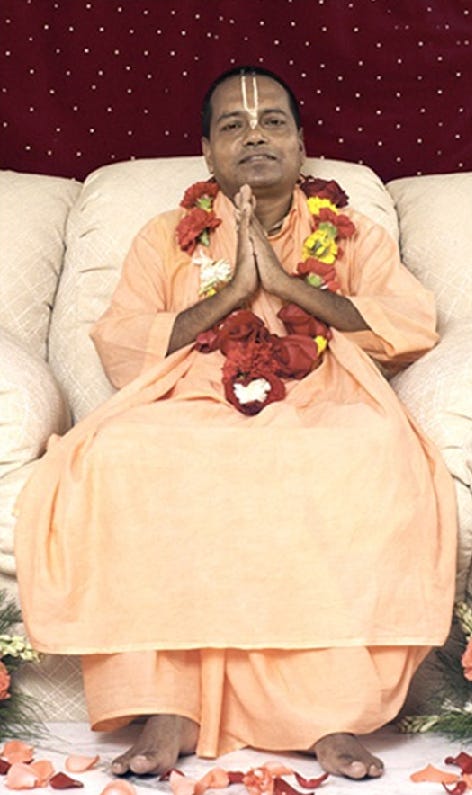
Śrīla Bhakti Nirmal Āchārya Goswāmī Mahārāj
from Guidance — Volume 1
Control the Root
Year 2012
The mind is always naughty, but you must follow Gurudev’s instruction.
You are young and sometimes do something a little wrong, but it can be forgiven: if someone is a surrendered soul, they have no offence. Practice makes perfect—it is not necessary to be a big scholar or a big scientist. Which university did Śrīmatī Rādhārāṇī go to? Did She go to Cambridge or Oxford? Rādhārāṇī studied in ‘Kṛṣṇa university’. She never went to Cambridge or Oxford, but we worship Her. Nityānanda Prabhu left His house when He was twelve years old: what school did He go to after that?
Mercy comes from above, but for that your pot must be empty—you must remove the ego that you are a great scholar, that you are very beautiful, and so on, from your pot—then immediately mercy will come.
Do you understand what my advice is? This is my prescription. If you follow it, you will be successful in your spiritual life, as well as material life (although a devotee has no material life—a devotee has only spiritual life).
Another point is that money must be used for service, not for enjoyment. You can go to Kolkata, Bombay, or Delhi, and spend two lakhs rupees (200 000) for one night in a hotel, but you can also go to Paharganj and spend 100-200 rupees for one night. Simple living, high thinking—what is necessary for your life, is sufficient for you.
Do not think or hope that you will get married and your son will look after you. He may not do that, then you will be hopeless. In another way, you may be upset that your brother is not looking after your parents, “He is my brother, so he must also look after them.” Instead, you must think, “No, no, why should he look after them? I will do it.” Always think in a good and proper way, do not think wrong…
If you follow me, you will be a great devotee, the only problem is that you must control your root:
Do not follow your tongue, always take prasād. You can take prasād even five times a day, no problem, but do not take anything except Kṛṣṇa’s prasād. Do not eat outside food—soft drinks, snacks, fast food, and so on. If you do not control your tongue, the rest will not be under control too,
jihvāra lālase yei iti-uti dhāya
śiśnodara-parāyaṇa kṛṣṇa nāhi pāya
“Those who go here and there trying to satisfy their tongue, follow their genitals and belly and cannot attain Kṛṣṇa.”
(Śrī Chaitanya-charitāmṛta, Antya-līlā, 6.227)
Mahāprabhu told this to a young boy, and who was that young boy? Raghunāth Dās Goswāmī.
If you control your tongue—if you do not talk so much, do not gossip so much, do not eat so much—it will be good for you; and you should practice from the beginning of the day. There is a Bengali proverb, “Uṭhanta mulo pattane chenā yāya: morning shows the day.” So, if you control all these things, it will be good for you. How is it possible to control it?
prasāda-sevā karite haya,
sakala prapañcha-jaya
“By honouring the Lord’s prasād I conquer all worldly illusions.”
(Śaraṇāgati, 31.5, by Śrīla Bhakti Vinod Ṭhākur)
If you do not control your tongue, your mind will be disturbed. Prasād sevā: always take prasād, do not take what your tongue and your mind wants. It is possible to do it if you try.


HEARTFELT WISDOM
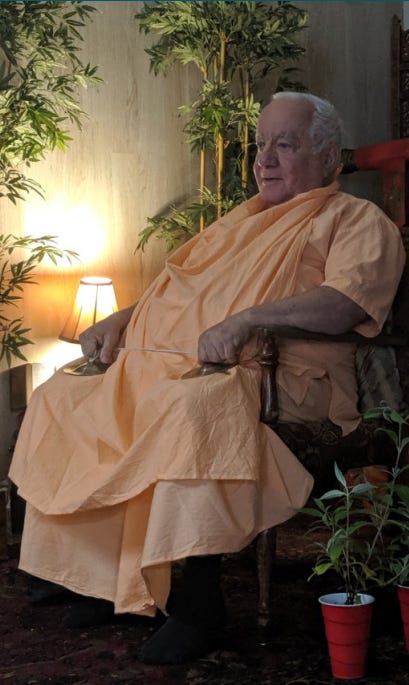
Śrīpād Bhakti Mādhava Purī Mahārāj, PhD
from Śrīla Prabhupāda’s Influence on the Scientific World
[This article is continued from the previous issue of ŚRĪ MAHĀNET.]
According to Śrīmad Bhagavad-gītā(4.9) janma karma ca me divyam, one who has transcendental knowledge of how the Lord appears in human shape is a liberated soul. Krishna is not an abstract universal principle but incarnates in the material realm according to our conception. In reality He is always in the spiritual world. From the absolute standpoint we can consider Gurudeva to be as good as the Lord Himself, ācāryaṁ māṁ vijānīyān, in different conceptions up to the dearmost servitor of the Lord. This is the conception of the devotee which Śrī Chaitanya Mahāprabhu Himself gave to the world. The Infinite comes down to us as His own devotee. The real worshipper of Kṛṣṇa, the genuine Vaiṣṇava is one who serves Guru and Vaiṣṇava in full surrender of body, mind and words. Jñāna-śūnya-bhakti we find the highest plane of service in the sensuous feature of the Absolute. Modern science is devoid of this type of scientific understanding, but by the teachings of the great acharyas like Śrīla Prabhupāda and Śrīla Śrīdhara Mahārāj such perspective is now available in the West. This is the real Science which Śrīla Prabhupāda came to teach. Once Śrīla Prabhupāda said that we should just try to apply our scientific knowledge to understand the mercy of Śrī Chaitanya Mahāprabhu. His life and teachings can fulfill all desires for knowledge and beyond that to give us the ultimate fulfillment of life — Love of Rādhā-Govinda.
In order to deliver this message to the scientific world Śrīla Prabhupāda established the Bhaktivedanta Institute with the help of his Ph.D. disciples Śrīpād Bhaktisvarūpa Dāmodara Mahārāj, Śrīpād Sadāpūta Dās, and myself. A number of conferences on Science and Religion were arranged by the devotees of the Institute at the beautiful temple-auditorium complex in Juhu Beach, India. They hold similar conferences at various times throughout the world. Calcutta was the site of the most recent one in January 1997. Śrīpād Sadāpūta Dās has written a number of books on a variety of scientific topics: Vedic cosmography, quantum mechanics, and aliens, as well as an influential book called Forbidden Archeology. He is presently at the Bhaktivedanta Institute in Florida. A number of other devotees have also written books. A few Noble laureates have taken a favorable interest in Śrīla Prabhupāda’s movement. Dr. George Wald, Nobel laureate from the biology department at M.I.T., has shown some interest. Dr. Wald made important discoveries about the effect of Vitamin A on the eye. Vision is impossible to understand on the basis of mere mechanism. So naturally one has to inquire about the existence of another principle besides matter to explain some simple observations such as visual illusions like the Nekker cube, for example. Here we look at one object but “see” it in different ways — as a flat figure of intersecting lines, as a three dimensional cube facing left or facing right. Such a variety of perspectives of a single object by a particular eye is the effect of a meta level of reality operating outside the physical level of the eye.
Professor H.P. Stapp of Lawrence Berkeley Laboratory has written a book called A Report on the Gaudiya Vaishnava Vedanta Form of Vedic Ontology. He is an internationally known quantum physicist who describes Gauḍīya Vaiṣṇava philosophy as a coherent, consistent and more complete conceptual framework for science than the presently accepted paradigm. The good work of the devotees of the Bhaktivedanta Institute is all the result of Śrīla Prabhupāda’s preaching mission in the West.
Śrīla Prabhupāda explained that we daily observe that life comes from life. A dog comes from a dog. A human being comes from a human being. Everywhere we look we see that life comes from life. Therefore why should we conclude that life comes from matter? Science means observe and then draw some conclusion based on those observations. We observe that life comes from life, but has anyone ever observed life coming from chemicals? No. Then how can this idea be scientific? Observation or experiment does not support the theory that life comes from matter. Without supporting evidence, imaginative theories are not science. This was his simple argument.
That matter comes from life is also observable. Śrīla Prabhupāda pointed out that our urine contains so many chemicals produced by the effect of the life force in the body. The Indian scientist Jaggadish Chandra Bose carefully measured the amount of water and air used by a growing tree. The weight of the tree, soil, air and water was greater than the sum of the additions. This means that the tree was producing matter from some unmeasurable source. Philosophically, we can understand that spirit is the truth of matter, the truth that matter has no truth. Beyond the experienced world, and the experience itself, is the plane of the experiencer or witness, the knower. Vedic literature teaches that beside this knower there is also a superknower or Paramātmā. The supreme Śrī Bhagavān is established as the actual spiritual ground of Reality, and not the material ground. Māyā or the illusion of the material existence is real. Māyā actually comes from “ma” which means “not”, and “ya” which means “that.” So what is “that?” The Truth or “that” is actually Kṛṣṇa, so māyā means to see “not Kṛṣṇa.” These are all transformations of conscious energy due to the modes of ignorance, passion and goodness. The psychologist Carl Jung once said, “Matter is a symbol we place over reality which may in fact be spirit or anything else; it may even be God.”
The U.S. landed a man on the Moon in July 1969. Śrīla Prabhupāda insisted that they did not go to the Moon. We all thought this meant that the U.S. was involved in some type of conspiracy to fool the public. Later as it became clear to us that they had actually gone to the Moon, Śrīla Prabhupāda explained that they had not really gone because they could not enter the atmosphere of the Moon, they had to take their own atmosphere with them. Also they could not see the presiding deity of the Moon, and they could not stay there. Therefore they did not go to this higher planet in truth. At that time we realized that our way of seeing in physical terms was different from the way Śrīla Prabhupāda was seeing things from the perspective of the conscious world. The scientists did not enter the plane of consciousness that the Moon represents.
We have noted that a similar situation has arisen concerning Śrīla Prabhupāda’s statement that we sometimes become envious of Kṛṣṇa’s position as the enjoyer and thereby fall into the material conception of life. One engaged in the activities of serving Guru and Vaiṣṇavas, may be considered to be on the spiritual platform. However, we may still be carrying some atmosphere of the material tendencies with us. For example, Śrīla Prabhupāda explained, if we are lost in a forest but can find someone who knows his way through, then we are as good as liberated simply by following the guide. One engaged in spiritual practices is as good as liberated, but the tendency to again fall into material existence may still be present. This tendency however, is never present for one who has left the material atmosphere completely and entered the spiritual realm of the absolute world. One can remain there permanently. This is the verdict of śāstra and of those who have knowledge of the truth. It is inimical to faith to conceive otherwise. One who is a surrendered soul has no tendency to enjoy separately from Kṛṣṇa, this is the meaning of surrendered soul. Reality is by itself and for itself, as Śrīla Śrīdhara Mahārāj was fond of telling us. One who is for Kṛṣṇa is surrendered to Him. Only the taṭastha-śakti section can fall under the external energy or bahiraṅga-śakti. Those in the antaraṅga-śakti are impervious to such influence. Śrīla Prabhupāda was fully aware of these things, as is clear from his books, but we may understand it differently according to our platform of realization.
[This article will be continued in the next issue of ŚRĪ MAHĀNET.]
SCIENTIFIC SANKIRTAN UPDATES

Dr. Kamala Maddali, a cancer researcher based in Philadelphia, recently published “From Precision Medicine to Planetary Health: How My Cultural Roots Reconnected Me to Science, Spirituality, and Ecology” on LinkedIn. This article describes what Dr. Maddali has taken away from her experiences with Krishna Keshava Das from the Princeton Bhakti Vedanta Institute.

Our new podcast discusses how spiritual/religious faith can foster environmental stewardship, and how environmentalism can, in turn, open people to contemplating their relationship with the Divine. This podcast is being launched on the auspicious occasion of Narasimha Chaturdashi 2026.
Ep. 1: Environmental Ethics & Ancient Indian Spirituality
Ep. 2: Self-realization, Deep Ecology, & Local Action
Ep. 3: Ecological Concerns from Ganesh Nimajjanam at the Raritan River

The latest Awakening Self blog post includes reflections on India’s relationship with New Jersey, USA, and how discerning between mechanistic and organismic modes of thinking, being, and becoming can help personal and organizational development.
ABOUT THE PRINCETON BHAKTI VEDANTA INSTITUTE
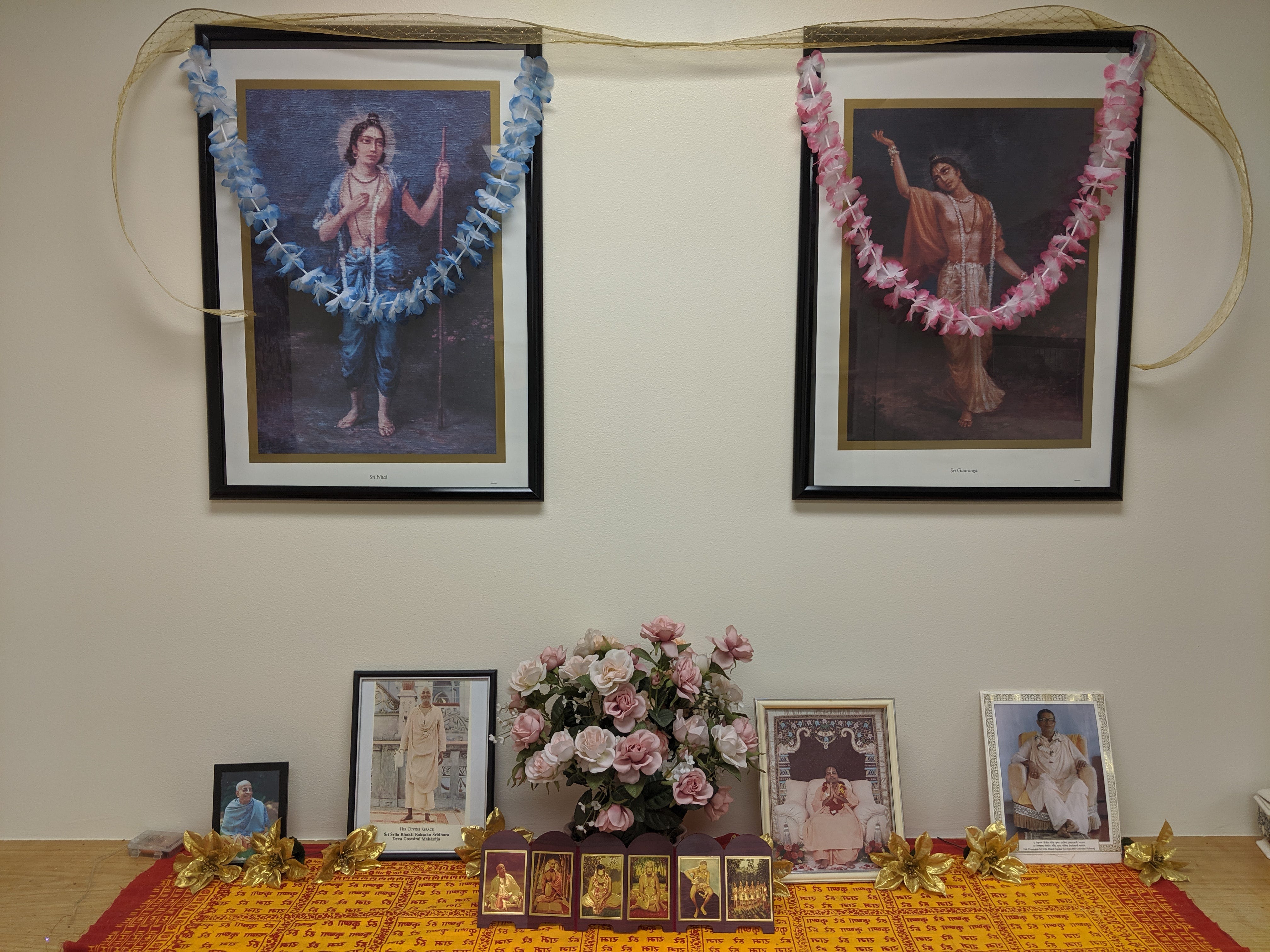
The Princeton BVISCS is a center for the advanced study of the nature and origin of life and matter, utilizing the ancient Vedic insights into consciousness and the self. The Institute consists of a body of scientists and scholars who feel that existing scientific models are too restrictive to account for the observed phenomena of life. Modern science revolves around the concept that everything, including life and consciousness, can be fully explained and understood by recourse to matter alone. The Vedic scholars on the other hand, who made the study of consciousness their primary concern, held that conscious life is primordial and cannot be reduced to physicochemical phenomena. This is the essence of Bhagavad-gita verse 10.8: aham sarvasya prabhavo mattah sarvam pravartate “I, Krishna, am the source of all spiritual and material worlds. Everything emanates from Me.” Taking this hint, members of the BVISCS are developing new scientific paradigms incorporating consciousness and other higher order spiritual phenomena as irreducible features of nature.
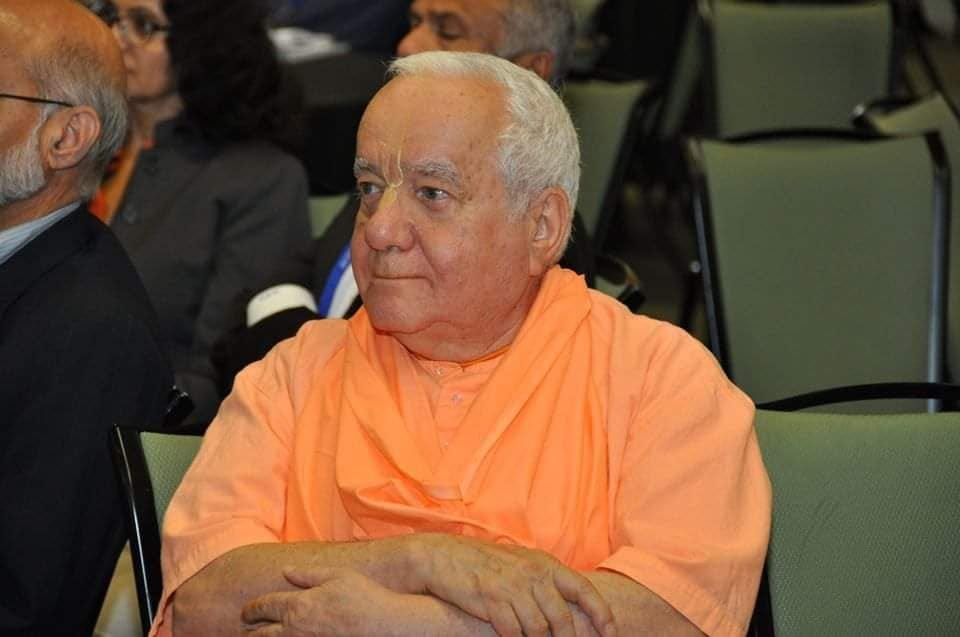
Śrīpād Bhakti Mādhava Purī Mahārāj, PhD
Serving Director
Śrīpād B. M. Purī Mahārāj, Ph. D., earned his undergraduate degree at Rutgers University and completed a Masters and Ph. D. in Theoretical Chemistry from Georgetown University in 1970. After completing postdoc work with the National Bureau of Standards in Washington D.C., Dr. Purī moved on to rigorous study and practice of the Bhagavat Vedantic philosophy and Bhakti yoga. He was one of the five founding charter members of the original Bhaktivedanta Institute in 1976, and became the Regional Director of the office in Juhu, Mumbai, India for a number of years. After diving deeper into the study of the philosophical relation between Bhagavat Vedanta and Hegel’s Conceptual Realism, Dr. Purī returned to the United States in the 1990’s. He opened the Princeton Bhakti Vedanta Institute in 2012. Śrīpād B. M. Purī Mahārāj, Ph. D., is a harinam and brahmin diksha disciple of His Divine Grace Śrīla A.C. Bhaktivedānta Swāmī Prabhupāda and a sannyasi disciple of Śrīla Bhakti Rakṣhaka Śrīdhara Dev-Goswāmī Mahārāj.
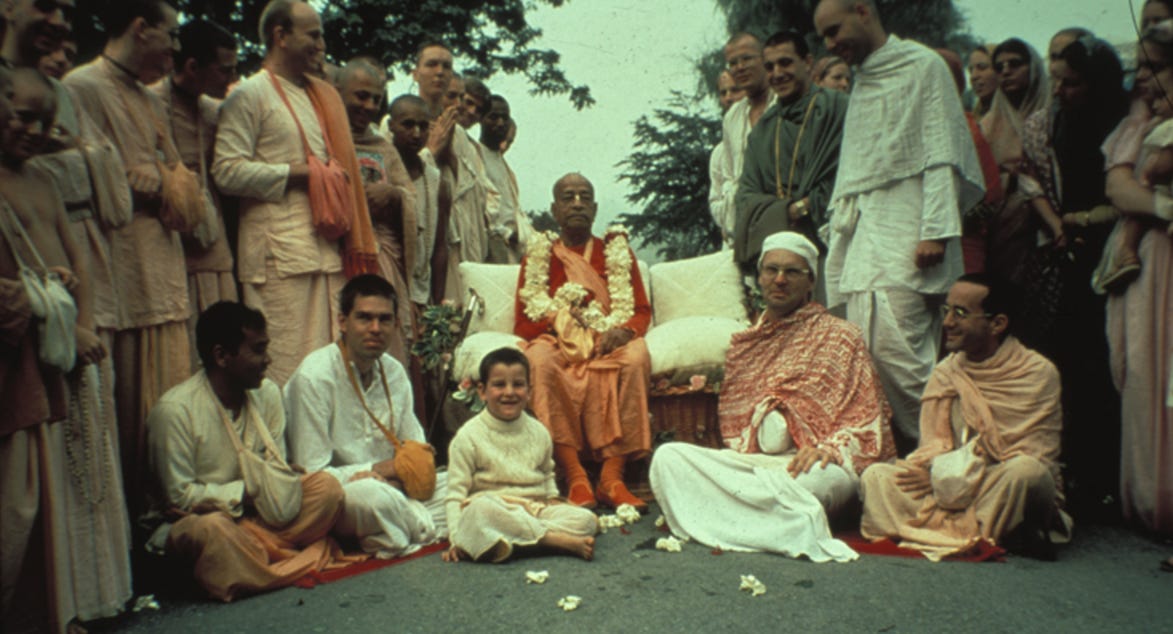
Kindly subscribe to the ŚRĪ MAHĀNET mailing list here
for quarterly newsletters discussing the spiritual science of biogenesis (life and matter come from life), the conclusion of knowledge (Bhagavat Vedanta philosophy), the subjective evolution of consciousness, and the path of devotion (Bhakti yoga).
For those interested in joining our WhatsApp group
for regular updates regarding the service activities of the Princeton Bhakti Vedanta Institute.
MBC TV - Mahaprabhu Broadcasting Channel on YouTube + Other Social Media Platforms
Editor: Kṛṣṇa Keśava Dās